Episode Transcript
[00:00:02] Speaker A: That same day, I quit my job with absolutely nothing secure. So I didn't have, like, any, how do you say, like, benefits. I didn't have anything. The only thing I knew is I was going to make even less money but doing something that I really loved. And so I just did that. In that same time, I met a bunch of great people in the e commerce space.
You weren't born to sit in traffic, work for approval, or wait for Fridays. You were built to be free.
Welcome to Rich and Remote, the show for the ones who dare to do life differently. Here we talk about building businesses that give you choices where you work, how you live and what you create.
This is for the entrepreneurs who crave freedom, financial freedom, location freedom, and freedom from everyone else's expectations. If you're ready to design a life on your own terms, you're in the right place.
Rich and Remote, hosted by Alex and Carla Booth.
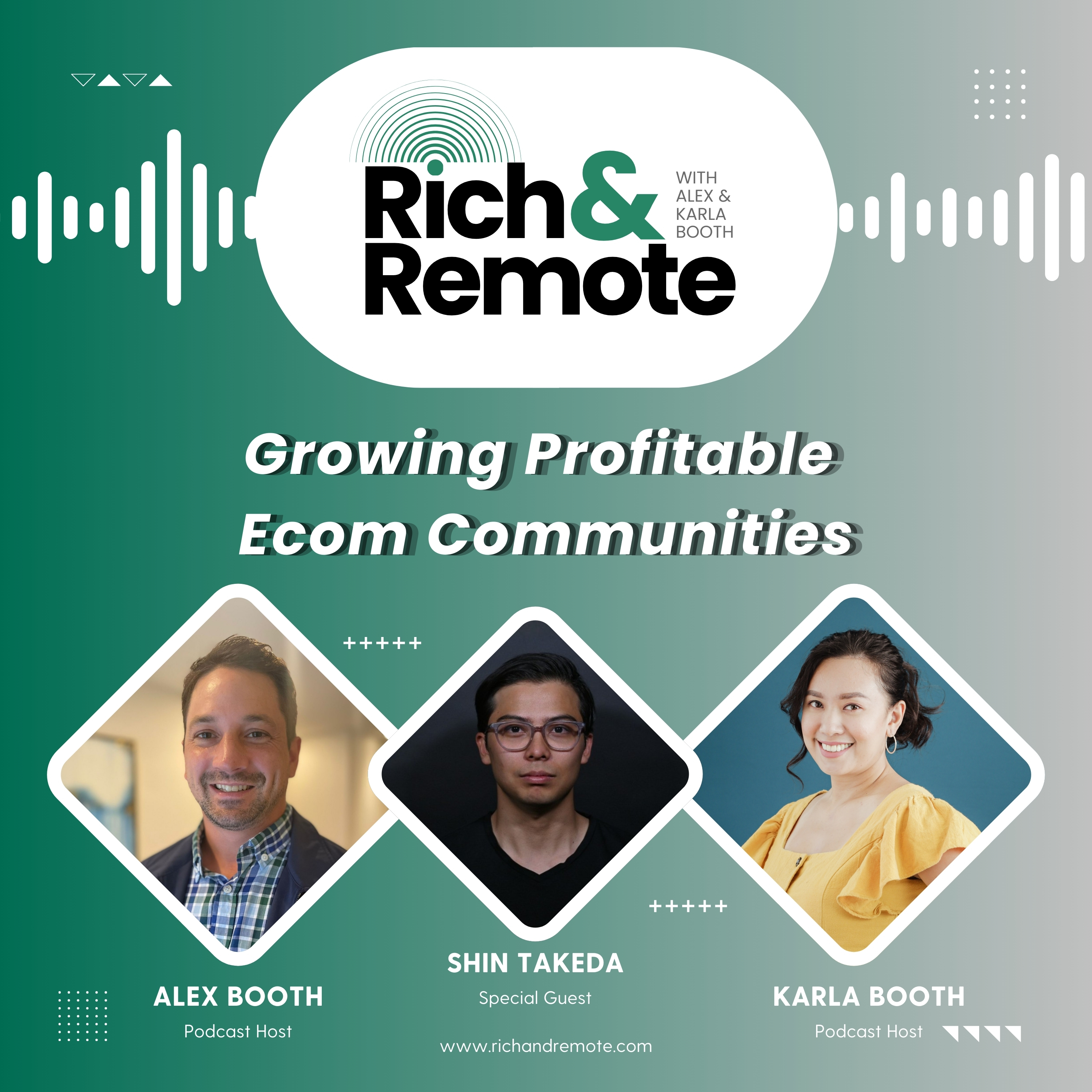
[00:01:01] Speaker B: Good morning and welcome to Rich and Remote. This is a podcast for everyone who wants to build a life on their own terms. They want financial freedom, location freedom, and freedom from people's expectations. Today we have a great discussion about building communities and funnily it is with, of course, Alex Booth, my co host and we have a guest for today. Our guest is also living a very inspiring hashtag, rich and remote life. We actually met on Twitter on X when he was living in Cancun, just an hour from Playa del Carmen, Mexico, and he didn't make it to the event and then we kept in touch and then we finally met, all three of us. Mexico City had a blast, but also we got the opportunity of really getting to know this guy, so. So our guest today is Shin Takeda and he worked at Endeavor in marketing. He also worked with Nick Sharma, running one of the biggest e commerce communities, also with Ron Shaw and other e commerce big names. So a lot of people know him in that realm. He also built a community for Axon, formerly known as Applovin, and currently he's also the head of growth for Refunnel. He's really good and knowledgeable at building communities and what this means for online businesses. So, Shin, how are you today?
[00:02:33] Speaker A: I'm blessed. I'm honored to be here. I'm working on the rich part of the equation, but I am already, yeah, I'm working on the rich part of the equation. I'm on it, but I'm grateful to be here. You both guys are awesome. Super fun to hang out with. So it's not only like a online conversation, but we, we know each other. We're the Rizzlers. We're the group of wrestlers for anyone out there.
[00:02:58] Speaker C: Shin is teaching me how to talk Gen Z right now. So I learned what Riz is. I got a few more things I've learned.
[00:03:05] Speaker A: Crazy work. Crazy work.
[00:03:06] Speaker C: Crazy work. Crazy work.
[00:03:07] Speaker B: Crazy work.
Yeah. Actually, every time Alex and I meet, like, we call them kids, but basically entrepreneurs in their 20s, we always learn something from them. We always listen to them.
I said, riz, Alex, I'm not gonna let that happen.
Yeah, Alex, of course, everyone, all of you guys know his business is in customer success. And he has a lot of really good insights about how communities and the strength of a community is in its heart, a customer success function. But we want to start with your story. Shin, maybe Alex can ask you some parts of your journey, but also, how did you get started in. In this interest in community management?
[00:03:55] Speaker A: Yeah, Beautiful.
My background is I studied international business in a Mexican school called.
I didn't like at all the degree, but I fell in love with marketing. And I remember the day that I fell in love with marketing, actually.
I was watching this video from a guy called Biaheza, and this is like an E commerce guy that did drop shipping day. And he uploaded this video called, like, I made a hundred thousand dollars a month at 18, and at this point, I had no journey in my life. I didn't know what I wanted to. I didn't know where I wanted to go. I didn't know anything. But I did know that I wanted to use my chronicle, like my chronic chronicle addiction to Internet throughout my years and live off of that. So I was that kid that always was on YouTube and just brain rotting. That's another word, brain rotting. Like the whole day.
And everyone was just telling me, like, oh, you gotta work and get a job and build up the. My brother is a super corporate guy and. And I just didn't buy it. I just knew that that was in my path. And so I watched this video. Coming back to the video, I came to this video, and I don't remember exactly the second, but I had a literal epiphany where I just was watching the video and then suddenly, and I swear on my life, I always say, I'm gonna see this when I die. You know, when you see your life that from one moment to the other, like, my whole life changed. My whole, like, priorities changed. Everything in general just changed. And I wanted to do Internet business, so I did drop shipping. I lost all of.
But I still had the love for it, right? So it wasn't about the money. It was about like I want to live off the Internet. I want to live off me being in my room not having to answer to anyone. Obviously now I realize answer to a bunch of people. But I still like that was the idea, right?
That failed. The pandemic hit. There was 2019, probably the pandemic hit and I just didn't know what to do. I knew I wanted to be an entrepreneur and so we had this like entrepreneur community called Endeavor is one of the biggest communities out there. And I was there as an intern, worked for six months and then before graduating I already had a full time job there, which I'm super grateful for. And then fast forward, I was there for like a year and a half, two years, like including my internship.
And then one day one friend of mine, he called that he had this opportunity of running an e commerce community for this guy called Nick Sharma. He's the founder of the agency of Mr. Beast and Emma Chamberlain and Gordon Ramsay and all those guys. And so it just made so much sense that I like marketing online.
I mean I like marketing, I like entrepreneurship and I was working in a place where it was community and I just said yes. And that same day I quit my job with absolutely nothing secure. So I didn't have like any, how do you say, like benefits. I didn't have anything. The only thing I knew is I was going to make even less money but doing something that I really loved. So I just did that.
In that same time I met a bunch of great people in the e commerce space. Ron Shaw, who built my O.B. the supplement company.
I worked with other entrepreneurs like Ramon Berrios and Blaine Bolus. They did this software called Cast Magic and I did a bunch of other stuff in the middle and and right now I'm building the community for a app network called App Loving which is the third biggest app network right now. So it's I think it's Meta, then TikTok and then it's Applovin but people usually don't know this app network.
And also I just recently joined refunnel Asset of growth and I'm super excited. We do UGC management. So there's Internet companies, they do a bunch of UGC influencer marketing, anything around content managing all of that and getting rights to the ads and just being able to product seed such. It's a super, super manual process and we just basically automate the whole thing. So that's me in a nutshell.
[00:08:15] Speaker C: Super impressive, man. I feel like sacrifice is always the key thing when you're making that transition, right? Like, there's always going to be a sacrifice. You got to make less money, whatever it may be. But why is it that I hear anytime someone gets in the drop shipping, they have to sacrifice all of their money? Why is. I feel like every time someone brings up, I got in the drop shipping, I lost all my money. I'm fortunate enough, I guess I haven't tried it yet, but maybe that's a conversation for another day. The one piece I'm liking. I've heard that before.
Yeah.
[00:08:46] Speaker A: Yeah, I would say that it's like mostly there's too much information, and most of them is scam. They're just trying to sell courses so they don't really get into the nitty gritty of, like, the operations of a business and how to actually scale. They're just trying to sell a course. And so I never really bought any of those, like, from some guy on X for $5. So I bought it that way. But again, I set myself with some unrealistic expectations as I was going to be making $50,000 in the first two months. And so I just ran with it and I just burned myself.
[00:09:19] Speaker C: Yeah, I mean, you found out that you have the drive, right? And that's really what it takes to be an entrepreneur, too, is the drive. But, yeah, I think if anyone, you know, listen to that, probably they understand how you've built up quite a bit of accolades. Man, it's really cool to hear what you've been able to accomplish. And, you know, Carla and I were fortunate enough to have dinner with you in Mexico City recently, and it was clear to both of us who walked away with that. That kid's going to be very wealthy. He's going to be really successful.
[00:09:47] Speaker B: So we need to be friends with him so we can be on his boat.
[00:09:50] Speaker C: That's why we're being super nice to you.
[00:09:52] Speaker B: Right.
I actually cursed Shin that night that we met him. I cursed him. I said, you will be a millionaire before 30.
[00:10:00] Speaker A: Oh, yeah.
[00:10:01] Speaker B: It's the best curse ever.
I'm a bruja.
Let's get straight into it, because a lot of people here will be building their online businesses and they will be so curious about community management. But a lot of people are also feeling intimidation because it seems like it's a lot of work. I. I see a lot of people who build communities and they really spend a lot of time in it. I can share a few stories of my friends making seven figures. They feel like they always have to be in their community, but what are the principles around this? So most business owners see community as a nice to have, not a revenue stream unless you have a membership. How do you bridge that gap? What are the specific ways a strong community can actually drive sales, retention or referrals? What do you think, Shin?
[00:10:51] Speaker A: I think it's a multifactorial like equation.
So one of the things that I've seen throughout the years is that yes, people think that community is not a driver of revenue, but I also think that they don't see all of the avenues that you can make money, right? So going back to like the first principles of like what is it that you're doing? You're connecting people, right? When you're connecting people. And I don't want to get super into this, but I'll just set the example as in you have the attention of people and we have. When you have that attention of people inside of a community where it's not about scrolling and you see another creator scrolling, you see another creator, you're just in that community. You can find other ways to monetize, right? So some ways we want to tie this online events, right? Or in person events. And this can be like having the person who's going to attend to the dinner pay in order to meet these like filtered people. Or the other way around. It could be a software company wants to pay 5 to 10k just to put their logo in the menu and that's a way to monetize, right? Then there's affiliates. If I run a community with a bunch of agencies and a bunch of brands, like getting to that connection, it's super valuable, right? That's why hiring is such a big thing. It's so time consuming, it's so labor intensive. So it costs a lot of money, right, to find the right talent. So same thing with agencies, same thing with freelancers. If you can make that connection, you can charge a percentage of the ticket that the agency is charging, right? There's a bunch of ways that you can do it and it's just a matter of understanding. Another thing is you've got to be very careful of like what type of community are you building? And this is like if it's going to be a community with a bunch of brain rot kids that are only watching TikTok and talking about building an Internet business in this echo chamber and discord community, then it might not work that well. So running a community with people who are filtered, with people who are actually doing the work, people who are like etc, etc, etc. That's how you actually build and monetize the thing. Another thing if I may say is that I've been running these like interview styles in the street for refund and I always ask like what's, like what's one thing that brands are getting wrong? Just anyone, what is getting wrong? And they always tell me that they are not talking enough to their customers. They are trying to guess what is the next thing, what is the next product, what is the next, et cetera, et cetera, et cetera. And when you have a community, you have this direct access to your users, you have this direct access to everyone who you can just talk to. You can tell them, hey, can I get a 30 minute call with you? And since they have gotten so much value from the community, they're down to get in a 30 minute call. And then that 30 minute call you can ask a bunch of things. What do you think about this new product, this new future with that we launch, what do you think about? You think about that and then when you talk with a bunch of people, then that's your data source. And data is king. Content is king, but data is also queen. And Roy is part of the royalty family. Right. And so yeah, it's just a matter of understanding those leverage, that's leverage that you have inside of the community that you can pull from.
[00:14:00] Speaker B: Right? Yeah, because basically what you said, like feedback for example, Alex knows the power of feedback and always teaches about how important feedback is. But in a community you can like scale that approach and you can also see how they interact with each other and then you can see what the general sentiment is of the group which will help you develop the next offer the next upsell, a down seller. So there's tons of opportunities there. Alex, what do you think are certain profiles of companies and brands that you think would greatly benefit from a free community? We can start there. A free community?
[00:14:42] Speaker C: Yeah. I'm kind of bullish on communities. Like if you looked at my content over the last two years, I'm super bullish. It's like been my number one thing I'm recommending to all brands. I'm honestly going to say like all the way from a product to like a course builder. I'm really keen on it. And the reason why I say that is because it takes a lot of, of resources, like the weight of resources off of your team. And if you build a community correctly, like you have knowledge sharing going on in that community that all felt on or fell on your customer support team, like your marketing team, you also have like New ideas being shared in that community. I. But if you're saying specifically free, like I don't think that there's any brand that wouldn't benefit from it to be honest. When you get into like a paid side, I feel like it's a little bit more prescriptive of where it works. Like, yeah, I'd say definitely, like courses are going to be huge. Right? I think courses nowadays, like they absolutely should come with a community. But if I were to say, like if we were to encourage a segment of businesses that aren't using free communities today, I would say like E commerce or just like product brands. Build a community for people to talk about your brand. Hey, I tried on these new Jordans, like I checked these out, right? Like they can share pictures, they can share ideas.
It's a no brainer and it gives you marketing material. It's a no brainer in my mind. And there's so many platforms now. Like, yes, a lot of people love Slack, but like you do have discord. You have WhatsApp groups, Facebook groups, anything out there.
It's. Yeah, for me it's, it's hard to narrow it down. Carla.
[00:16:23] Speaker B: Yeah, no, I totally agree with you. And even like telegram, like you can have like telegram kind of like groups. I think on Instagram you can also have your own like group chat. That is one way that you can send messages to the community and, and they can't reply. So you control like the conversation, which is in a way, in my opinion, replacing newsletters in a way. So I like that idea and honestly that is why I got inspired to pitch and build Rich and Remote with Alex, with you, because I wanted to build a movement and a community for people who want to live life at their own terms. And I've had this idea for a while, but I just never acted on it. And yes, there will be beneficial items for all of our businesses and everyone featured in this community, but ultimately it's also for me like a form of expression. Expression. So I would say as a content creator, building a community is also a good way for brands to exercise their expression.
[00:17:27] Speaker A: Yeah.
[00:17:27] Speaker C: Carla, I want to add to like I came from Amazon, right? And if what's the biggest thing about Amazon that most people experience is Amazon prime, right? They might not have the community where they're communicating with each other, but all the benefits of Amazon prime are literally things that you can get in creating a community now. Like you can get special sales just for the people in that community, right. You can give them discount codes exclusive to that Community, you can give them special treatment just like rewards for being loyal and getting feedback, giving testimonials. It creates a little ecosystem and it's literally what Amazon did 30 years ago. But you can apply it now to like any brand.
[00:18:11] Speaker B: I like that.
[00:18:12] Speaker A: If I may add something, here is one. I was recently talking with this guy that has a marketing agency that he does like TikTok shop for brands and he told me this one crazy stat and it's that only 1% of TikTok shop creators actually drive more than $1 in GMV revenue. And so the point that I'm trying to do here is that a bunch of these TikTok shop agencies and a lot of business I'm seeing like more and more they have a community not only for everything that we just talked about, but in the specifically E commerce space. Finding quality creators that actually drive revenue is extremely hard and it's a problem that everyone's trying to build long term relationship with creators. And what these agencies do is they have a disc with a bunch of TikTok shop creators. You can just plug it in, you can talk to them, you can build relationships inside of that specific and then you can just pull talent from there. Right. And with that being said, E commerce brands also are like companies or businesses that can definitely like it a lot from building a community.
[00:19:21] Speaker B: I agree.
I actually experienced that I have more loyalty to brands where I am a part of their community. Like Lululemon. I'm a part of their community. I don't even earn like loyalty points. They don't really give anything but they do kind of like give me like first dibs on what they're launching. And sometimes they would give 10% discounts or free shipping if I'm ordering something and I like it. And another community I want to shout out is Tiffany. I'm on the Tiffany newsletter and they said that if you're a part of their community you will receive like VIP treatment when you order something wherever in the world. Wherever like Tiffany office in the world. And I love giving Tiffany gifts as home like housewarming gifts. So my friend Alex and I, we have a friend in Spain who moved to a new house and we sent her Tiffany wine glasses. And it was so easy. It was so, so easy. And, and I like that because I was on their newsletter so I was more engaged, I was more reminded of their brand and it made me like a more loyal customer.
So I guess now we are beyond discussing that communities are beneficial for brands. What are some no nos shin in a Community. What are some actions, some things that should not happen or like if this happens in your community, you're doing something wrong?
[00:20:47] Speaker A: Yeah, I don't have the answer for every single type of community. Just because building a community is like building a website, you cannot quote them instantly. Right. It's a matter of like, it depends on what you're trying to do. But one thing that I've seen happen again and again is not being very strict with who can get into your community. Right. So one of our biggest challenges that we are currently having is the fact that this community has like over 6000 members.
And let's say that it's 6000 and then there's like 3000 of them are E commerce brand and then the other 3,000 are agencies or freelancers or SaaS vendors. And then at the beginning when I wasn't still running the community, they just let anyone in. Like anyone can come in and that just dilutes the quality of the community. When a member that is actually valuable, I mean everyone is valuable. But in this specific community, like a brand asks a question and what they're looking for isn't a pitch. They're looking for other brand that has had that same experience and that is trying to solve it. And they get pitched on their service, they get DMed about it. Then that's a big no, no, it just once they get pitched, they just don't want to come back anymore. They're like, okay, I came in here, I got pitched, I don't want to be here anymore. So that's one of the big nos that I would say for a community, being very intentional with who you let in and who you don't let in. And then on that same note, there could be moments where when you run a full scale community, you cannot be looking at like verifying that they said who they said they were. And so they could just come in, do a slack like profile, put a picture of Alex or Mosey and just come in and say it's Alex or Mosey. And then with the other members who think there's a serious community where it's only entrepreneurs, they see Alex Hormozy come in. That trust that you built around the community, when they find out that that's not Alex, it just crumbles. So, so that, that's one of the things that I would say the biggest one. I don't know, Alex, if you have something.
[00:22:51] Speaker C: Yeah, I totally agree. That's why it's like I've seen a lot of people start to. There's the large communities. Right. Where that's a huge issue and they have to monitor a lot, they have to police a lot. They have to empower their community to also police. Right. But then there's the people who have been just tired of that and then they're committing to the small communities and there's either in person or like a virtual, you know, interview process just to Jo.
Which is unfortunate that it has to come to that level because you have to sacrifice the scale in order to do it.
[00:23:24] Speaker A: Yeah.
[00:23:24] Speaker C: But I totally agree. Like their quality control if it's not done will totally spoil a community.
[00:23:32] Speaker A: Yeah.
[00:23:33] Speaker C: If I were to add one other thing to like a. No, no Would be. I feel like there's got to be direction in the community. There's got to be like a very clear purpose or else you're going to just have people taking over to talk about like crypto or whatever they want. There's. Because there's always people in a community that are most active and if there's no clear direction, then those people that are most active are going to turn it into their personal space to talk about whatever they want.
[00:23:59] Speaker B: Right.
[00:24:00] Speaker C: So you really have to make sure that there's clear intention in a community.
[00:24:04] Speaker B: Right.
Yeah. And of course another like scaled version of a community is like masterminds. Right.
So what I notice is that the best masterminds that Alex and I have been a part of, people would always say we want a community of givers, not takers.
So I think that once, in my opinion, once a community, I feel like this community has so many takers, I'm immediately going to exit that community. And of course it's up to the community manager to kind of eyeball that and build their intuition.
So let's talk about that. Because not a lot of business owners have personal time to build a community from scratch or you know, doing the day to day grind. So especially if you are very busy, you know, booking sales and like building your brand or if you have a personal brand that's doing talks and everything.
So community management is both a sit down and I get out there job. So you might not be able to do it all. So give us some tips, Shin. And I'm gonna get to Alex too on what are some of the best traits of a good community manager.
[00:25:17] Speaker A: That's a great question. If I'm being honest, I feel like I'm not a good community manager. I think that I'm like just brute forced my way into being a coaching community manager. Yeah.
That's just being that's just me being me. One of the things that I always say everyone is thinking about scale. I think there's even more value when there's a community manager that actually cares about who's inside of the community and the connections that you're doing. Like the subject around the community. Right. You like E Commerce, then you run an E commerce community and you do a community around dogs. And so just being very intentional on, like, what is it that you like and building around that and not the other way around, which was a mistake that I did at some point in my entrepreneurial business that I said, like, okay, I'm going to build communities for everyone. And I found myself running a community that I didn't like, that I didn't enjoy, that my clients weren't like, cool or stuff like that. And then on that same note is doing things that don't scale. And that means like making those introductions one on one, having that conversations one on one with the members, like remembering who they are, making a small cohort group of people, and they just following up with them on what they're doing and being very intentional. When we run a community, I think that everyone wants to scale. I think that's the opposite here. Of course you want to scale, you want to grow your community, you want to do a bunch of things, but what you really want to do is consolidate that small group of incredible fans that are around your brand, around your podcast, about your business, around everything. And so that's what I would say is one of the best traits. And be very patient also.
[00:26:54] Speaker B: I see. Yeah. So it seems like someone who has a really good intuition on like, people, a real people person, so that the connections come easy for them. We can't really hire someone who is a natural introvert and doesn't want to talk to people and all of those things. What about you, Alex? You're a really good job interviewer. Actually, my team learned a lot from Alex as well. What would you look for and what questions would you ask when you are hiring a community manager?
[00:27:23] Speaker C: Yeah, I think one probably trait that would be missing a lot of times managers, we probably want someone to understand a little bit of a business mind. Like, because people join a community to get something out of it, at the end of the day, it's not always that they just want someone to talk to or that they just like always want to reply. Like, I think it's always, it's good to have someone that understands that they need to get value right and trying to figure out a way to get them value. And if they just get lost in communication and making sure everyone's responded to and nothing ever gets moved towards getting the value, I feel like there could be like a loss of attraction for the community.
So beyond what Shin mentioned, all the traits Shin mentioned. But then also I'd be looking for someone who has somewhat of an understanding of business. Right. That knows that there is importance for time to value.
And that is a really important measurement in customer success is once someone is onboarded to a community or like a service, how long does it take to get them their first value?
[00:28:25] Speaker B: I like that.
[00:28:26] Speaker C: Yeah, I feel like from an interview perspective, I'm assuming that once they've gotten to the interview with me, they've had their qualifications checked, so they check all the boxes. I'm just going to be doing behavioral questions. I love behavioral questions. So I'm going to have my leadership principles down. So maybe one is business minded or data oriented, extrovert or, you know, a strong level of ownership. And then I'm going to be asking them questions like tell me about a time in a community and X, Y and Z happened. You know, what happened? What did you do? What was the result? And then I'm going to probe deeper and deeper into. After they answer the question, I'm going to find out more. They think they've answered it, but no, I'm going to go like five layers deeper and keep asking questions and I'm going to keep doing the tell me about a time question and pretty soon you're going to figure out if they answered where. I understand the situation, I understand their behavior and I understand the impact of what their actions were and the situation.
If I feel like they were able to answer all that and it exemplified the principles that I'm looking for, then they're a good hire. And to be honest, that is the entire interviewing style I have. I've ripped it off completely from my time at Amazon. They really trained me well. But it works. It works really well. You find people who tend to make really good business owners and entrepreneurs too, doing it that way. You can have someone that came from Yale, but you could have someone that also got to the same interview with their grit. And, you know, the Yale person couldn't answer those questions and the other person could. And a lot of times I don't even like to look at resumes because I don't want to know where they came from. I just want to know the behavioral answers. Yeah, yeah, I agree.
[00:30:05] Speaker B: Especially because I mostly hire people from the Philippines. And when I See what's school you come from. I automatically have a bias, and I just can't help it. So I'm the same Alex. When I interview, I don't want to look at their resume. And sometimes I want to look at the resume in the part where they worked, but in the Philippines. It's funny because the way that we do resumes is like, we add the city we're from, we add our school, we add, like, sometimes even, like, hobbies. Someone would even add, like, I want, like, Ms. Cancun 2002 or something like that. And it's funny. So I really like those points on what to look for when hiring community managers. Another thing I would add is participation in physical communities. Like, are they part of the hoa? Are they active in the pta? I also personally look for that because it shows their natural appetite for being in a community.
And this is a secret, but I would also prioritize or prefer people who have siblings.
Interesting over, like, only child. Because I think if you grow up in a house, in a home, with different people, with more people, I think it gives you a basic training on how to handle different personalities.
And then, of course, your experience in your home and your experience in childhood builds up your first experiences in conflict management, conflict resolution, your sense of justice. Right. When someone takes your toy, and then you have a feeling of, what should I do? Is this right or wrong? So I feel. This is my opinion. I feel like if you grow up with siblings, you have more consideration for others, unless you're a psychopath and you have, like, more compassion and more generosity of your time because you kind of grew up to, like, giving something to people around you. So that would be my opinion.
[00:32:02] Speaker A: That's awesome. I never thought about that, but it makes so much sense. And considering also that I'm a big believer of that, as in, like, your upbringing definitely shapes you, like, who you are in your character. Right. But I never made that connection between, like, community managers, like, having siblings, which is such a good one. It is really a good one.
[00:32:23] Speaker B: Yeah. Let me tell you, Shin, when I was single, I avoided guys that were only child. They just were different.
I'm gonna stop there. I don't want to get canceled or get attacked.
[00:32:38] Speaker C: Yeah, I have another good one. I think it's really important that people nowadays to be successful community managers, assuming they're probably working remotely, like online. Right.
[00:32:46] Speaker A: That's what this podcast is about, that.
[00:32:48] Speaker C: They have a life outside of work.
Right. There's too many times I've been hiring people. They even do on the behavioral questions. Right. And they fit the role. But the just the burnout is real or just like the temperament is wrong. Right. I feel like someone needs to have a balance. Like, they have to be happy outside of life. Maybe it's just going to the gym or like, they like to hike, but they have something going on outside of life or outside of work life. I think nowadays it's just becoming increasingly important and it allows them to also relate to people. Right. Oh, you weren't able to respond to this because you also have a life. They can understand the people in the community better.
[00:33:27] Speaker A: That makes. I was having this conversation with you also, and I agree so much on that and like, the importance of having a balanced life, of having something outside of work, of having, like, support columns in your life that you can go out to and talk to them. Because then you, again, if you don't, you just end up in this, like, individual echo chamber where you don't really can interpret reality the right way. You cannot get, like, what does my friend think? What does my mother think? What does my grandmother think? And if you're just isolated and just thinking about, like, work and nothing else, then of course you're going to end up not performing well.
[00:34:04] Speaker B: Exactly.
[00:34:05] Speaker C: In a bad day. As a community manager, you imagine if you take that bad day out on the community, it's not one client, it's. It's, you know, sometimes thousands of people that you're taking your bad day layout on. Absolutely.
[00:34:18] Speaker B: Yeah.
[00:34:19] Speaker A: Oh, my.
[00:34:19] Speaker B: Yeah.
Let me tell you, I've seen influencers, creators, or business owners with big followings and with communities that would crash out on their Instagram Live or like, they would just, like, cry or they would, like, yell at people.
And sometimes I think, is this guy's hormones, like, off or something like that? Like, what's going on? Seriously? Seriously. Like Wes Watson, for example. I don't care.
He always crashes out. Yeah. On his Instagram Live or something. Which, to be honest, he actually built a community of young men who were rooting for him. Right. And I think he doesn't know how to manage his emotions very well and he would just crash out on his community. So I guess the other benefit of hiring a community manager is as the business owner, you get to provide some sort of distance. If you are not feeling well and you can't show up, then your community manager can assist you with that. So that's another benefit. Let's talk about profits, revenue. Let's talk about the money.
So what are some of the best practices in Community management that actually bring in the money.
[00:35:33] Speaker A: Interesting.
Bringing the money.
I mean I would say like building those relationships, like actually Talking with the SAT, like the SaaS, people talking to them, talking with the brand founders understanding. And it all just ties again with it just all ties together. Right. So if you're a person who actually cares about other people and you're asking them, you're communicating whether you're talking with them, you might find out oh, I need to hire this person or I'm looking like for this specific software. I'm looking for da da da da da. Software companies, they oh, I'm looking to get more clients in my budget. I have money to spend a dinner, like three dinners.
Some same with single like ICP that you have inside of there. And then it's a matter of like reverse engineering that and seeing how you can make money like that way from their needs. Oh, I'm thinking about, do you have any like recommendation for a software where I can find ad inspiration? All right, there's foreplay, right? And so go out there to Foreplay, do an affiliate link, send that affiliate link to him, put that on database and then track that. And then when someone ever asks again for that, then you can do that and you can send that same affiliate link and then you can do it with hundreds of different programs. You can do it with hundreds of different things, affiliate things. Another one is this is not so related but in clients with money, if you have clients that don't have money, there's there and it's, I saw it when I was 16, 17, 18, I was like no, no, no, I need a client. I definitely need a client. And maybe there's an argument where you need to take shitty clients when you're starting out, but then when you don't need to take those shitty clients, like find people with money because they're going to pay fast, they're not going to be a pain in the ass and they're gonna let you cook. They're not gonna be inside trying to see what's going on. They're just gonna let you cook. Yeah, crazy, crazy work.
[00:37:30] Speaker B: Yeah. No, I agree with you. I really like those approaches. Like for me when I was starting my business, I really delved a lot into affiliate marketing and growing my affiliate community. I would run like raffle contests, affiliate contests and each person, it was a small community, actually it was like less than 50 people. But I really paid attention. I had a special newsletter just for them. And then I would be extra, extra mindful of how I can Also give to them as, as other businesses in my industry. And that was my own little way of like I'm gonna take care of this community because there's a direct link with that community to revenue. What about you Alex? What can you share about some best practices in community management that directly tie to customer success and of course with that maybe increasing LTV or revenue.
[00:38:27] Speaker C: Yeah, no, I really want to drive this point home and give specific examples because I feel like I've been shouting for the rooftop that community and customer success directly drives revenue. And just like I don't know why I have to keep doing it or like the rest of everyone else is doing it too. But I, I feel like the first thing that is like really obvious is identifying and nurturing referrals and case studies. So people that are going to be advocates or are advocates, you can nurture them to become super affiliates and to build case studies. They are building an army to promote your brand right there that is way more affordable than the ad spend that is not always going to provide for you. Right.
So number one, I feel like that's a huge one. Number two would be promoting any upsell you have testing out offers on the community.
Think about a brand that is launching a product.
You do a launch initially to the community.
E commerce so hard to get a product off the ground. But if you have a dedicated community that you know you can give it to them first and the numbers already support it, like your Amazon product for example already has, it shows that you already have people wanting to buy your product, now Amazon wants to buy it more. The same thing is true with like in any other E commerce space or just in general, even a service based business events. Like you can use your community to create events and create content around your brand. So I think just leveraging community for new offers, creating events is absolutely huge and I think those are the really big ones. But you can also like generate new ideas. Like get the community to give you ideas for what you should be creating. That's that feedback we were talking about.
If a lot of times we think we know what we should be creating as, like as a business owner. But we're creating it because of what we think, but with not what our customers or community actually wants. They will what they will buy, what they will spend money on, listen to them create it and you automatically know you have something that works. Like yeah, the amount of time that you shorten by listening to the community to create that is going to save you money already.
[00:40:46] Speaker A: That's going to drive revenue and 100%. 100%.
[00:40:52] Speaker B: Yeah. No, I totally.
[00:40:53] Speaker A: It's just a matter of being creative.
[00:40:55] Speaker B: Yeah, yeah, exactly. Yeah. So what are your suggestions, Shin? Like you talked about creativity. Is it the crazier the better? What are some of your advice to create meaningful interactions within the community and activities that make it unforgettable.
[00:41:11] Speaker A: Yeah, yeah. The crazier the better. For sure. It might not always work, but when it does, it's a home run. So I would definitely say crazy, but that's really depends on like the character of the person. So I am not risk averse. So I just burn the boats every three months on stuff. Like I just burn the bolts all the time. Like if I think like, okay, they're paying me $4,000 to do this, but I really want to like hit it off. I'll spend an extra thousand dollars just to make sure that it works perfectly.
And then it's the matter of, yeah, what you just said. Test stuff. Like test a bunch of different stuff. And then again back on, like, talk to the members. What do they want? A bunch of threads around. Like, it's Black Friday, Cyber Monday is about to come in. And you see a thread where they're talking about how do I structure my finances. Or there's this big thing with Trump and the terrorists coming on right now. You also need to see like, what's going on though that like macroeconomic in the space and have that thought process where, okay, this is happening. I run an E commerce community. It might make sense to something around those lines, right? So micro, it could be like people talking inside of a thread asking specific things about, hey, can someone. My landing page. And that's how we came up with our most like, popular segment or content, which is like, we bring in a landing page or website expert, like a designer that is super specialized on Croatia, and we bring him on, he gets the leads of the people who join the community. And then what we do is we have people like send your website. This person is gonna like go through your website live and it's gonna tell you what, like, this changes. And that. And that really became like, of course there's a bunch of people that did it. But it was just a test. Saw people saying, like, can someone help me with that website? Can someone help me with this? Can someone help me with that? Create like a cool experience around those needs. And one more thing is that I, I hate webinars. And I've always hated them. And I join webinars. I'm like, who's buying from these Things sometimes it's just background of some people, they're listening in, working something that they just leave. Right. So if you can create a good experience where the whole school, the host knows, like, okay, now is the turn of this person and then they have character and it's interactive. People can be asking questions. People can get only from what they're trying to preach. But what like solving problems for someone else inside of the community. Then that's how you get those 80% attendance rates. That's how you get a bunch of leads from these webinars. That's how you get like quality, like interaction actually providing value and not just trying to push your agenda all the time. Which is something that I see a lot of people do in social media and communities and everywhere. It's just about like, listen to my message, listen to my message, listen to my message. But I just think we're upside down. I don't think that's the way it should be done, to be honest.
[00:44:10] Speaker B: Yeah, you're right. It's like the focus is on the offer owner instead of the people that are in the community.
It's like the government, you know, the focus should be on the people.
But no, so it's not, it's, it's backwards. Like you said, it's backwards. The focus should be in the people and the members of the community. I love that. Well, we definitely learned a lot and I hope that our listeners, this inspired them to build a community around their brand. It can be a simple, honestly, you guys can do this with 10 to 15 minutes a week or even a month if you want. Just a simple newsletter.
Say hi to the people that love your brand, that maybe follow you on social media. It doesn't have to be a full blown thing what Shin is doing. But of course if you guys are ready for real expertise in community management, you can approach Shin. And if you want the connection to build customer success systems around your community, definitely hit up Alex. So Shiny, you, how can people get connected with you? Tell us.
[00:45:19] Speaker A: Yeah, beautiful. So you can find me on LinkedIn as Shin Takeda. You can find me on Twitter as and I don't know, can you write this down, the description? Because they probably won't know, but it's Shinosuke underscore san. And then on Instagram you can find me like Ecom with Shin. Yeah, and yeah, that's pretty much it. I can give you my WhatsApp if you want, but I'd rather not.
[00:45:44] Speaker B: Be single. Girls will be texting you. Shiny.
[00:45:46] Speaker A: Oh God's Plan. God's plan.
Let's run some, like, super targeted ads to this, like, clip specifically.
[00:45:57] Speaker B: Okay. Now it's serving you and not the community. So what about you, Alex? How can, how can people find you?
[00:46:05] Speaker C: Yeah, you can reach out to me on LinkedIn. It's just Alex Booth. And then if you just type in Huckleberry after that, you're gonna see me pop up on consulting and then get csm. Either of those work too. So, yeah, happy to talk to you about customer success.
[00:46:20] Speaker A: Beautiful. All right, can I say my last message?
[00:46:23] Speaker B: Yes.
[00:46:23] Speaker A: And actually this is the first time I'm saying this last message, but I'm going to say it, like, whenever I go into content podcast, I'm going to say this, which is number one, do what you love and then make it happen or die trying to right a mic drop.
Make it happen or die trying. Yes.
[00:46:43] Speaker C: Like, no cap.
[00:46:45] Speaker A: No cap.
[00:46:48] Speaker B: I love it. It reminded me of this Will Smith quote where he said that whatever he chooses to do, he will always give it his best. And if there and he wants to be the best at it. That he said, if you are going on the treadmill with him or beside him and he's on the treadmill, either you will get off the treadmill or he will die on the treadmill. And those are the only two possibilities. And that really, like, fires me up too. Because if you really care about your business, nothing else matters. And every day might feel like your back is against the wall, but do you want this life or do you want a regular life? Right? For me, every time I have a difficult time in business, sometimes I cry sometimes, like, there's so many things on my calendar, and then I take a breather and I think, but you know what a job, right? Like, I chose this path because having a regular job is not my path. It's not my truth, and it's not what serves my life. So.
[00:47:56] Speaker A: I'm sorry, there's a question for both of you guys.
Has this been easy? Like, has this been, like, easy at all?
Should our listeners expect this or whatever they're doing to be easy? Or they're. Or they should expect, like, failure after failure after failure after, like, being broken down and then just coming back up and like, like, good. Frank Sinatra says, when I find myself facing the. I forgot that you just get back up and you get back in the race again.
[00:48:25] Speaker B: Right?
[00:48:26] Speaker C: I feel like literally there's a saying, like, you have to life raft, right? Like, there is no going back. And I feel like every step I've made after leaving Amazon has just been it's either success or failure. And that's how you have to treat every single step. Right?
So, yeah, it has not been easy, but it's easy in the sense that I know every time I fail, like, okay, I know that I'm gonna figure out a way. Right? Yeah, that's like there's literally no other way. So.
[00:48:57] Speaker B: Exactly.
[00:48:58] Speaker A: Amen.
[00:48:59] Speaker B: Yeah, it's this or nothing. So I like that. Well, thank you so much, Jin. And thank you so much, Alex, for all of their accounts and businesses. I'm going to share it in the show notes. And thank you so much, guys for joining us. If you have any comments, feel free to comment it down. If you're listening on Spotify, Apple Podcasts, or even finding this link in your socials, we'll be happy to reply to those messages. If you have any suggestions, definitely message me. You can find me on socials as well. A lot of my social media platforms this has been rich and remote. Thanks for listening to Rich and Remote, where freedom isn't a dream, it's a decision.
This is Carla, this is Alex Booth, and this is our journey to our dream rich and remote life.
[00:49:46] Speaker C: If this episode inspired you, share with a friend who's ready to live life differently too. This is perfect for entrepreneurs who crave financial freedom, location freedom, and freedom from the opinions of others.
[00:49:59] Speaker B: And don't forget to leave a quick review. It helps more freedom seekers find this show. Big thanks to our sponsors, Huckleberry Consulting, getcsm and Proximity Outsourcing.
[00:50:12] Speaker C: See you in the next episode and check out our online hangout spot, richandremote.com.