[00:00:00] Speaker A: I think opportunity is going to be a big one. You might not understand the full scope of the opportunity that you'll have to grow in your career until you get into the role. Some companies, they oversell the opportunity to be surprised like no one in the company has moved beyond their current position.
Some people might be surprised and think the role is ca. It's a role that they have to be in for a few years before leaving and then they find out I have a long term career, I can become director in this company, I can move up. So I feel like just eyeballing when you get into a role, what are my long term opportunities here? Because it might not always match up with what was presented to you during the interview process. You weren't born to sit in traffic, work for approval or wait for Fridays. You were built to be free welcome to Rich and Remote, the show for the ones who dare to do life differently. Here we talk about building businesses that give you choices where you work, how you live and what you create.
This is for the entrepreneurs who crave freedom, financial freedom, location freedom, and freedom from everyone else's expectations. If you're ready to design a life on your own terms, you're in the right place.
Rich and Remote Hosted by Alex and Carla Booth.
[00:01:39] Speaker B: Hey, quick one for anyone still doing $15 an hour work when you should be doing $10,000 an hour. Thinking if you've ever tried hiring a virtual assistant and ended up with someone you had to train from scratch, I want you to check out the Hire an AI VA playbook which you can
[email protected] It's a $17 toolkit that shows you exactly how to find, vet and hire an AI savvy virtual assistant. Someone who already knows how to use ChatGPT and Claude properly so they can actually take work off your plate in as early as three hours and not in three months. It has betting checklists, masterclasses, job post templates, prompts and even done for you AI Skills Test will even guide you through the interview process so you'll truly have everything you need to land a proper AI enabled virtual assistant who can finally take these tedious everyday tasks off your plate. Link is in the show notes so go grab it and do yourself a favor. Once again it's higher an AI VA.
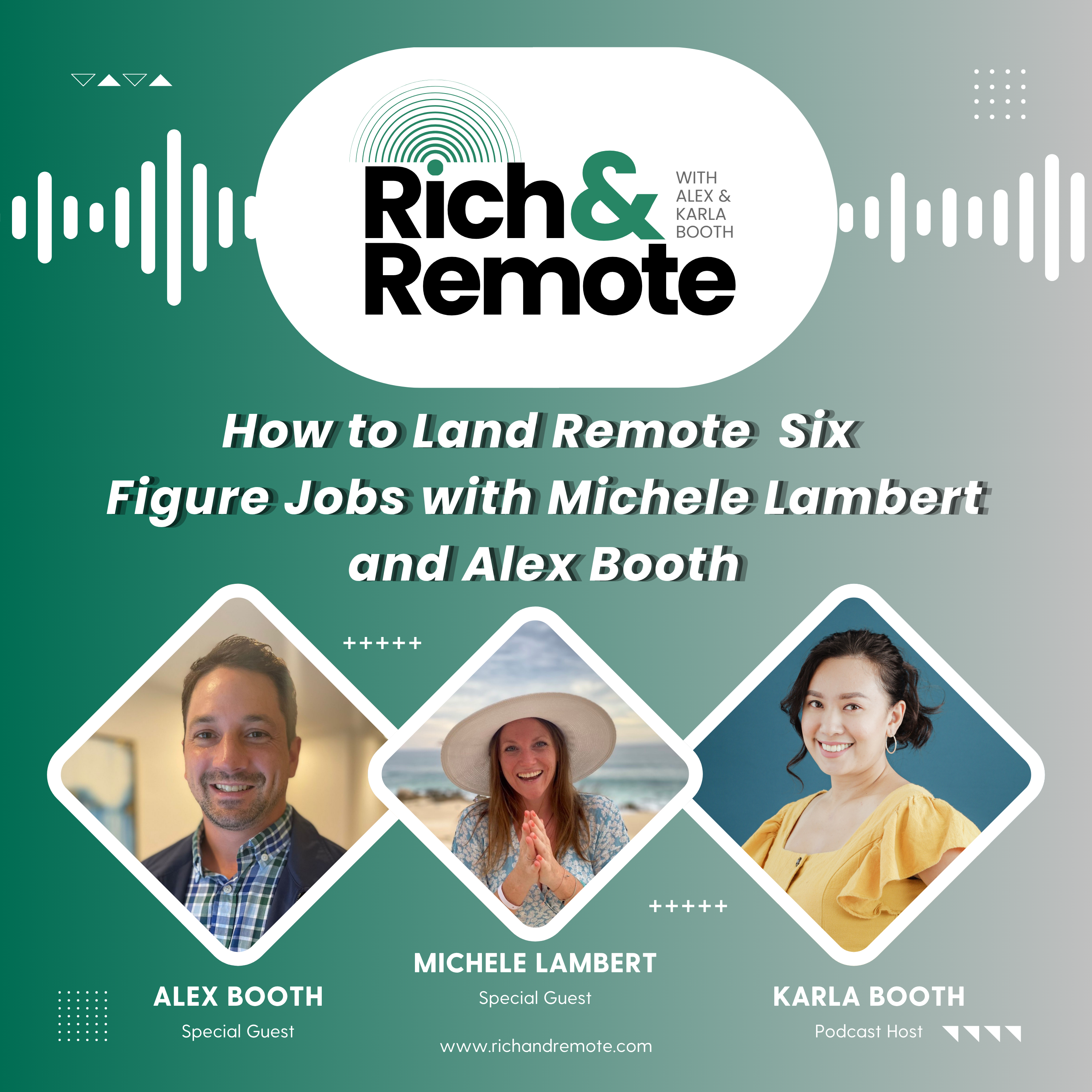
You deserve high quality support and you deserve an AI savvy virtual assistant. Go check out Hireanaiva.com Good morning and welcome everyone to Rich and Remote. Today is a very special day because we are going to discuss what it really takes to land a six figure remote job. Everyone's talking about how expensive the eggs are, how expensive gas is, how expensive everything is.
But a lot of people are also complaining that maybe their salary or their initial source of income might not be able to catch up. Now because of that, there hasn't been a better time to actually land a six figure job because we all know that that is kind of arbitrarily what will get most households to maybe a more comfortable place financially. And I guess a lot of people will agree to that. So today we are going to answer some questions. We're going to reveal some of what the industry recruiters or the decision makers might not tell the public.
So today I have two very awesome guests. One is Michelle Lambert. She is one of my good friends. She's the founder of Bella Connections and a trusted authority in building high performing teams for seven to nine figure online businesses. Her expertise began in marketing, operations and leadership long before recruiting. So she actually worked inside both brick and mortar and digital companies building, leading and optimizing teams. And in 2012 she moved fully into the online business world. Before remote work was cool, before the pandemic where she built and managed remote teams that powered multi figure seven figure growth. And she also supported a lot of New York Times best selling launches, created operational systems that continue to scale years later. She is definitely one of the most sought after recruiters in the industry.
And through her company Bella Connections, she helps online businesses hire marketing operations, creative and support leaders based on skills, cultural alignment, personality and motivation. So that's our guest number one. Michelle, we're very happy to have you here. And of course Our guest number two is Alex Booth. He is the founder and CEO of GetCSM. It's getcsm.com and his expertise is focusing on customer facing roles. So I know Alex because he's my husband and also my partner in everything I do, business wise. And he, he has a decade of experience in customer facing and customer success roles. From yellow Pages to Microsoft to Amazon, he has helped a lot of companies make more money by improving their customer experience, satisfaction, retention and lifetime value. So when it comes to hiring the people that will make your customers happy, make them stick, make them spend more money with you. You gotta call Alex. So welcome Alex and welcome Michelle. How are you guys?
[00:06:01] Speaker C: Awesome. Thanks so much for having me. I'm excited to be here and get to talk with you guys about this. I know we have had some chats privately and I'm excited to hear Alex's expertise and yours as well, Carla. So thank you.
[00:06:13] Speaker A: Yeah, I'm super happy that you're here, Michelle. Obviously I'm one of the co hosts for the show so this isn't new for me to be here. But I don't get to see your face often. I see your name everywhere.
We exchange emails occasionally. Always happy to do that but like I haven't seen your face and it feels like years, you know.
So really happy to talk with you about kind of a shared industry, obviously different ends of the spectrum, but really happy you're here.
[00:06:38] Speaker C: Yeah, super excited. Thank you guys.
[00:06:40] Speaker B: Right, okay, so we're getting ready and I know that if you are active on social media, maybe if you're scrolling you will see the term six figure job. Six, six figure man, six figure lifestyle, a lot. So what does that really mean in, you know, job wise when someone says I want a remote six figure job, what do they actually mean and how far is that from what you place people in? What types of people usually get a six figure job? So let's start with Michelle.
[00:07:15] Speaker C: Yeah, I mean if I'm being honest, the industry and the placements that we're typically doing are really for like high level leadership, especially marketing leadership, which is typically a six figure position.
You can of course work your way up into it through a bunch of different ways. You know, I've seen, you know, my, myself as well, you know, growing up or just dabbling in different areas, I guess, you know, you can start in, in one part of marketing, start getting a little bit more experience with a company, start getting a little bit more chance to grow into different departments, different responsibilities, things like that and eventually kind of grow into that higher level roles.
Whether you know, you're really interested in media buying, like the senior media buyers do really well. So do you know, creative strategists and directors.
As long as you have like a lot of experience in one area and you just really dive into your specific specialty as well as understanding how to manage people. So it's, it's getting the skill set and then the management skill set as well. At least that's the experience I've seen. What have you guys seen?
[00:08:18] Speaker B: Yeah, what about you, Alex?
[00:08:20] Speaker A: I agree with Michelle. I especially like that you said like that one area. Right. I feel like we're gonna probably dive into more of commonality of seeing that with some later questions. But I think from like a job seeker's perspective, I don't think there's like anything to decode here. I think people are really clear, like they want to make six figures and they want the job to be remote. Like at the end of the day I think people want their freedom back. Right? And it's funny because like a 6 figure job just hitting that 100k mark is now like equivalent to what we were looking at 50k salaries, you know, not too long ago.
But from like an employer's perspective and it's going to be someone who can come in and like they don't have to handhold, they can actually start making decisions, they can actually take over that leadership role.
A lot of these employers have probably been hiring people for much lower right. And maybe they've gotten someone to six figures by promoting them or giving them incentive goals like hit these KPI targets. Um, but when they're like out there posting to hire a six figure person to come in, their expectation is I'm tired of having to train these people and get them to a certain point and I, it feels like I'm just taking a bet and then I get them to a certain point and they leave. I need to bring someone in where I don't have to do that for anymore. Like they can come in and make an impact on day zero.
[00:09:44] Speaker B: I really like those distinctions. First is, I like Michelle, what you said about it has to be a mix of skills and experience plus leadership. I really like that. Also, quick question, what is skills and experience? How many years does someone have to have under their belt for them to be called experienced or an expert in something?
[00:10:03] Speaker C: That's a great question. I don't know that I always necessarily have to look at years because there's also, you know, there's, there's a lot of things that come into that like how much are you diving into it, how much are you learning, how much are you really like trying and testing? It's it more comes from, you can understand experience more from their thought process, how they look at things, the different experiences and career highlights that they've had, the wins that they've had, how they've been able to turn things around. So I'm looking a little bit more at that than specifically like you've had six years of experience here. Like obviously, you know, couple years, especially if you're, you know, in a management role or something like that. A couple years in a specific niche is incredibly important. Like you need to have that level and at minimum. But I wouldn't say that I'm going to put a number on it only because the, especially in the industry that we're working in, it's a lot of startups and they just move so Quickly. So a lot of people are really looking for that hungry person who wants to quickly jump in, get things done, try it out.
So yes, you need experience and understanding. You know, the marketing side of things, that's an important piece there. But you also need to be able to be hungry and pivot quickly. So at least that's, that's what I've kind of seen. What about you guys?
[00:11:12] Speaker B: What about you, Alex?
[00:11:13] Speaker A: I totally agree. I feel like marketing's probably a little quite a bit different where there's a lot of like specific hard skills to learn. Right. And that experience takes time. I feel like maybe there's a little bit more leeway in the customer success, client facing role. Like if someone is generally really good in front of clients and they have experience, growing accounts in general, maybe like the proof of their labor, their accomplishments can fill in the gap versus like X amount of years. But typically we're seeing like over five years of experience. If I had to put a number on it. But if someone had three years of experience, but they did it at extremely high level, they have all of these accomplishments that they can speak about and it can be backed up with some validation, I think that also fills that gap of those extra two years.
[00:12:03] Speaker B: I like those nuances for sure.
In my experience. I had this funny story about interviewing someone for actually a customer success role a while ago, Alex, before you started your business. And it was so funny because on her resume it said that she had 10 years as an, get this, as an assistant team leader. And so I was like, 10 years as an assistant team leader? Why didn't you get promoted as a team leader?
So, you know, it doesn't mean that you're an expert in being an assistant team leader. It shows me that there's something in there that prevented your superior from, from promoting you. Right. And I was able to find out really quick actually. So you guys are absolutely right. It's not. The number of years is not always the main determinant. It is a mixture of things, but it is, it says something, right? It says something. Someone with one year experience of course is different from someone with five years of experience. And of course it's going to show in the interview.
Let's give the industry a little bit of trivia. Give me one role or one job title that people will be surprised in your industry, that people will be surprised to find out that that job title pays six figures a year.
You can start, Alex.
[00:13:19] Speaker A: Well, I mean, I'm pretty narrow with the roles that I hire, to be honest. So I don't think it's going to be a surprise of my answer. I mean just like a customer success manager in general, you absolutely could and should be making six figures when you're making, I feel like when it's at the right company, right. So it just depends on the company that you're going to start working with. Additionally like I feel like even if you don't have that base salary of six figures, you can still get there with performance. Right? Performance based bonuses can, can get you there and that could be a surprise to some people. Like they might see a salary of 65k right. And then they end up making 110k because they just absolutely crushed it. They took on a lot of responsibility, maybe they earned trust and their role expanded. So I think customer success would potentially surprise some people.
I don't know if it would surprise people in the US because it feels like it's very common for like 150k to be like a salary for CSMs. But I think outside the US maybe.
[00:14:27] Speaker B: What about you Michelle?
[00:14:28] Speaker C: Yeah, I definitely agree with that. Especially US anything honestly like the prices and inflation, everything else going on here. Like I feel like majority of the roles that we're hiring for the, they always have at least that performance based incentive to get to them to a hundred K or more. Um, so like affiliate managers, copywriters, media buyers, like they always have something kind of back there or based in it that's going to get you to that goal. So I definitely agree with that. The performance based incentives shouldn't be overlooked. I feel like a lot of business owners are really leaning into those more because they want the ability to say hey, you hit these certain goals that allow us to grow so that I can commit to that kind of a salary. And that's where you know, they may not have it in the moment that their first doing it or it might be a really scary first hire to, to say yeah, let me give you 100k but if they can say let me give you 65000 and then we'll have performance based incentives so that you can hit that 100k. So I know that you know, I'm hitting the marks that I need financially to be able to support that income. So I feel like that's kind of where I've seen a lot of businesses really transition to right now.
[00:15:34] Speaker B: I like your examples because sometimes people are just looking at the pay or at the salary and then that's the only thing that makes them want to apply to a role and sometimes they they skip the part where they think, am I really a good fit for this? And there's nuances in roles, right? Like for example, in Alex's experience, there is a role that is like director of client experience, retention specialist, or you know, so these are all customer success roles, but there are nuances in each role.
So what about oversaturation guys? What are you seeing in the market as an over saturation in terms of role? What roles do you place that you're surprisingly finding a lot of unqualified applicants. And what do you think is the reason for that?
[00:16:22] Speaker C: I can jump in here. I don't know that I necessarily have like a specific role that I'm receiving. A lot of unqualified. I'm actually receiving a lot of overqualified and a lot of just really well qualified people. Like right now it's less of a chance of oh, you don't have the right skills. It's, it's more of like there's so many people that have exactly what they're looking for that they're choosing between three to five people with that specific years of experience, that specific book of business, a specific type of business, that specific type of funnel. Like it's crazy, like the amount, like the level of detail and you know, where the business is now and where they're trying to go is the other thing too. So like they might currently be, you know, at 500k a month or something like that and they're looking to do a million a month. And you're sitting at, you know, your experience has been 300 to 500 in businesses, 300 to 500k a month. But this other person has experienced 500 to a million a month. And that's the person that they're looking at because that person has the experience of where they're looking to go. So honestly, there's been amazing talent, there's amazing people applying. I'm not seeing as much under qualified as I'm seeing. It's really competitive right now. At least that's my feedback. What do you think, Alex?
[00:17:31] Speaker A: I totally agree and I would say even in my realm it's like if there's any over saturation, it's people with the same level of experience, right. Even if it's, there's a lot of people even coming from the big name companies, right. It seems like it's hard to differentiate people. And where I would like to potentially see desaturation is people having those pieces of experience or skills that separate them from other people. Right? Like maybe it's Like, I'm really good with go high level. I spent a lot of time in ghl, you know, just, like, these one little nuances that separate them from everyone else because it seems like everyone's coming in qualified, but they all look pretty similar. Are you seeing that, too?
[00:18:17] Speaker C: Yeah, and I definitely agree with that. And especially, like, the specific experience. Experience, like you said, go high level or something like that. Like, a lot of people are asking for that. And what I found is, you know, some candidates might not specifically have the experience in that platform, but they've been actually reaching out and, like, playing with it themselves so they can learn it. And that's where a lot of people are like, okay, this person's doing it on their own. Like, I'm gonna go with them and, you know, get it. Give them a chance to figure it out versus just saying, hey, you don't have that exact thing, so it's worth, like, playing around. So I really like that you said that.
[00:18:52] Speaker A: Oh, my God. That's it. That's like, my home run hires right now is people who invest their personal time into learning these skills. And you can see it right away in the interview. It's like, okay, this is what I do, but this isn't who I am. Right? They'll be talking about the job, but the past job experience, what I have been working on is I've been learning anthropics and, like, all the. All the how to use Claude. This is what I've been building, or I've been getting certified and playing around with ghl, like, all these different things that show that they're generally interested in progressing their career. Right. And building more of a. Of. Of a resume. Those are the people that I'm seeing, like, jump off the page right now. Right. Is like, they're investing their personal time. And Carla and I, we went to a conference a year ago where Mike McCalwick. That's how you say his name, right? Carla? Yeah, yeah, yeah. So he had this reference where he said, you're hiring for, like, people with potential when they. They all kind of look alike. And he said Home Depot used to do this thing where they have, like, Bird House building for kids or all these different workshops, right? And they're actually using them as, like, hiring events for. They'll be, like, recruiting the parents, not the kids, because they're, like, investing their personal time and teaching their kids how to do these things. And you use that as, like, an example for how you should do hiring in a lot of places. It's like, look for the people who are investing their personal time. And I thought that was a really credible source.
But I've also seen that really work out for us is finding those individuals.
[00:20:27] Speaker B: I like those points. A lot of things really come out during those interviews. Huh? Let's walk back a little bit about like resumes, certifications, credentials. What do you think are some credentials or certifications that are actually truly impressive? And what are some credentials or certifications that are not really that impressive or maybe are super overrated? I'm going to, I'm going to start.
So for me, of course, since I hire a lot of roles in project management and in operations as well, we don't really do admin or virtual assistant roles anymore when we hire from the Philippines and Latin America, it still surprises me every time someone adds to their credentials Google Business Suite or Microsoft skills.
Yeah, Google Docs or. And then sometimes they would list all of the Google, like Google Docs, Google Calendar, Google Sheet. I'm like, good for you.
I'm at Gemini. I'm working over at Gemini now. Gemini does everything Google for me now. So of course, with the change of the landscape in terms of AI coming in, that is still surprising to me that some applicants would make that the highlight of their resume as their credentials or their certification. What about you, Michelle? What are you seeing? What are some really actually good credentials and certifications that people should pursue?
[00:21:56] Speaker C: Those are really good points there and I like that a lot because I've definitely seen.
Sometimes it feels like it's just filling the resume with words and we don't want that. Like, you know, some of these things are basic. We know that we can use them or you, you know, it's not make or break. And I find that being more specific in a resume is most helpful for the person who's reviewing the hundred plus resumes and who's reviewing your final resume and going through it and deciding whether you're a fit or not. If you have that specific experience, you have specialized experience, those kind of things. So anyways, in terms of certifications, if I'm being honest, the space that I work in, in the online business director sponsor space, they rarely care about schooling, specific education programs. You know, if you graduated with a business degree or a marketing degree or any of those things, I don't know that I've ever had a client ask or care if I'm being honest. That being said, like we were saying earlier, investing your time and personal time into the skills that you're looking to grow, showing that you've had you know, experience in that specific suite and what kind of, you know, what kind of programs you've taken in that. Different masterminds, things like that. Like, are you actively looking to train and grow your experience in this specific space? So those are the kind of things that I look at and I usually ask for what kind of programs have you invested in in the past? And that's what I'm looking to see.
[00:23:16] Speaker A: Yeah, I think on our side, it's. I've seen a lot of people and I actually was this person at one point. So this is going to hurt me actually saying, but maybe they work at a faang company, right? The Facebook, Amazon, Google. What's the other one?
Anyways, you know, the big companies, Netflix, and they think that they automatically are going to be like, top contender for the role. And I honestly was one of those people. I left Amazon. I'm like, okay, I'm good. I'm going to get a ton of interviews. And it wasn't that. That wasn't the case.
And I'll have a lot of candidates that I put through because I related with them. They worked at Google. Congratulations. Like, you and I can have a great conversation about our war stories at these big companies. Right. And when they got to the interview with like, my clients, like, they just couldn't relate on a certain level with them. They didn't have the specific experience.
Whereas, like, I think at the big companies, you do get kind of spread out a little bit or you get really narrowly margined into like working in a very specific thing, but not a tool that's applicable outside because they have so many internal tools. So I feel like just relying on your experience at a big company as like through credential, it might speak to you getting hired in the past, like the background check said they performed on you. But in terms of like your ability to come in and make an impact on a company, I'm seeing it not being. Translating well. Like, I would rather see someone has like a project that they've been working on or like the things Michelle has been mentioning, like where they're investing their time into learning these different skills and getting better.
[00:24:56] Speaker B: Yeah, I like those distinctions and the certifications, really, sometimes they just give the interviewer something to start with. Right? Like something to start with asking. It's like the movie and the dinner date formula. Right. The reason there's a movie before the dinner date is to guarantee that you have something to talk about during dinner. Then you talk about the movie. I think sometimes certifications are. It's just Kind of a guarantee that, okay, so you did this. How was that? How did you use it? And then the interviewer can start diving in. So that's the conversation on credentials and certifications. What about things that disqualify candidates? So tell me about maybe some moments on a first conversation with a candidate where you already know you're not moving them forward, or maybe that they're not ready to take a remote job.
So I'll start very quickly. For me, it is if they don't answer a question directly.
So sometimes if I notice repeating myself two or three times already, then I know that it's not going to work out because they're not going to be a good communicator. So at that point, I'm already kind of checked out. What about you, Alex?
[00:26:10] Speaker A: Hey, cards. Let you know you have. You have a lot of background noise. My answer to that would probably be pretty similar. It's the fact. The first thing I do notice is that someone will ramble immediately. Like, yeah, you ask them a question very specific. So, like, hey, can you tell me about yourself, maybe where you're from? And then they spit out every single thing about themselves in 15 minutes. They're very. They're very much, like, not conscious of the questions being answered or allowing the interviewer to actually lead the conversation. They wanted to spit every single thing out right away. For me, it's just like, why even continue the interview? Like, we know this isn't going to work. Obviously, it's nerves. I feel like a lot of his nerves. So a good interviewer might recognize this and be able to try to calm the nerves and then reset and maybe even give them, like, a little bit of instruction, like, hey, I'm specifically looking for you to answer this.
And if that works, then you can judge if, you know, this person is actually a good fit. And it was just nerves. But usually it's just right away that I see people just try to get everything off of their. Their mind. Right. As soon as possible.
And it's just a bad fit if you're expecting this person to come in and handle client relationships. Right.
At least from my, my lens. Yeah.
[00:27:30] Speaker C: Yeah, it makes a lot of sense because they're going to do that to you. They're going to do that to the clients and to the customers and everyone else.
Yeah, I would also like. Yeah, I would agree with both of those. It makes a big difference when somebody is able to, like, directly say, like, what it is, like, respond to the answer with an actual experience of something and clarity. So What I would recommend, because both of these, I feel like has helped in the. Helped me in the past when I go into these things is always just take at least five minutes to like meditate for or just, just like breathe for a minute before you go on these interviews. Because we get so wound up before them that we like blurb all these things or we're not clear in our answers and stuff like that. And that, that I feel like is something that just is an immediate deterrent for me. I think the other thing is, I mean, I've seen people show up without shirts on. I've seen them show up looking around, like all over the place. Yeah. Like, it was for like a fitness rant, so I guess they thought it would look cool to like, be topless. I'm like. And it was like an all women's brand too. And this was a dude and it was just not fitting. And so I think reading the room in that way, like, being professional. I've also seen people, you know where I see them in the interview, and they're just kind of all over the place, bouncing around, eyes everywhere. Clients say that too. And they're like, I think they were on something or just being careful about, like, what, how you're showing up to the interview. And I think being professional. And I don't think that you need to practice every little thing. I think that for me personally, what helps is, is going through my past experience. Like, before I jump into something, I go through a list of, like, things that are related to this specific role and this company that I have experienced in the past. And then I have like a quick jog list in my memory of to be able to pull up those actual experiences and speak to them clearly. And I'm not saying spend hours going through it, but just have a list of that kind of stuff for you. And if you want to go like before an interview and just look at it so you can be able to quickly bring those up, that kind of stuff helps. But those are some of my big ones.
[00:29:31] Speaker A: I would be curious, Michelle, if you have this same thing you're looking forward to is like, I want people to recite numbers to me as well. Like, I want what they're talking about to be measurable. I don't care. And visit. Maybe I shouldn't say this, but, like, maybe you're making the numbers up. Right? Like, maybe you don't remember the exact impact you made 10 years ago on a particular brand campaign. Right.
But maybe you can speak to it. Like, you do remember those Exact numbers. And not in a totally unrealistic way, but so I understand that you can have that conversation. You know how things actually work. Right. So like I want measurements. Do you guys feel the same on your end?
[00:30:08] Speaker C: I think yeah, I definitely want to speak to that because measurements are a big, a big piece and that's why that list really helps. You can write down those measurements before.
But also, yeah, when people like get on, especially in a marketing role where it's very data focused, when they get on and they say, oh, I don't know, I don't really pay attention, I don't remember all the numbers. It's like you can't really make decisions from that standpoint and people are looking for somebody who's data backed decisions, not just emotional fly with it. At least in most of the roles that we're looking at. Being as specific as you can like. And if you don't know the numbers, say, hey, I'm not absolutely sure, but I'm pretty sure it was a fit within this range. Like that's a fine thing to say.
[00:30:44] Speaker A: Totally. One other thing, do you guys look for this too? I want someone to answer a question in a way that I understand everything that they're talking about. I don't want them to like go on the tangent. I'm not saying that by everything I mean I want to understand the situation of what you're talking about. I want to understand the steps you took, like your behavior and I want to understand the impact. I think that's like the measurement part. Right. If I can understand that, then I feel like you answered the question properly and it might be like a good structure of how you think about it. Everyone think talks about smart, like smart goals and answering questions smart. I like simplify it. If I were to give advice and to say sbi the situation, behavior and impact. And if you can make the interviewer understand the situation of what you're talking about, your behavior in it, and what was the impact, you're golden. I feel like that's a proper way to answer any question and a good thing to keep mentally keep yourself in check and not like go rambling. But it might help a lot of people. Actually.
[00:31:45] Speaker B: I like those points. And your story about a topless interview, Michelle is still super funny to me because it's like, is he overthinking the remote part too? It's like, oh, I'm ready to take this remote job. I'm super casual, I don't really care. I'm detached to the outcome. I think that person took it very, very far.
But, but thank you guys for sharing. Yeah, a little too, too far, but it's almost, it's a great story to tell because like you said, it was like a fitness offer. So maybe he was thinking that would give him a better chance at getting you a job, but it just screamed unprofessional. That's pretty funny. So of course there are failures from the side of the applicants, but sometimes there are also failures from the side of the companies. Maybe they're not writing their job description properly or maybe their job description sounds like it's a scam or maybe it's actually a scam. Can we help our job seekers a little bit? What are your guys advice and what is the best way to look at a job description to know if it's a scam or not? And what is the best way that they can maybe make a good first impression, maybe in that cover letter or if they decide to reach out to the CEO directly. What are your guys's advice?
[00:33:00] Speaker A: Honestly, I don't recommend reaching out to the CEO. A lot of times I feel like that's why they have a team that they're hiring.
It can be a really bad taste. So just be careful about doing that. I think in terms of like what you're looking for in a job description, there's always going to be a point where like maybe you don't meet 100% of the criteria. Right.
But don't overstretch it. I think there should be like a balance of, Okay, I meet 75% of the criteria, I can be honest about the other. And do they explicitly say like, this is a required skill set? Right. Like obviously you can apply for those for roles and it's up to the recruiting team to filter you out if you don't meet those. But I've seen a lot of people just go ahead and apply for roles or lie about their experience, like ghl. I've used this as an example a few times, but people will say they have a lot of GHL experience and then they get on an interview, they get asked one basic question about it and it's clear that they know what GHL is, but they've never used it. They don't even know how to navigate it in their brain. But I just don't. I think like, I do think that you can do yourself justice by like being realistic about what your skill set is based off of the job description. But don't count yourself out of like all roles too. I'm trying to emphasize That I think like a red flag for me is if like a mass or a vast majority of the compensation is going to be like a performance. Right. Like if it's a vast, vast majority. We were both, and Michelle and I were both talking about how great it is to like earn your way into that, that six figure with the performance incentives. It shouldn't be like 80% of your, your revenue to get there. I think those companies, a lot of times they're turning and burning employees and they're not investing in them. Right. So you think that you're going to be joining and going through a training and really it's a little bit of a waste of time. They're just trying to get people in to do a job and they're not planning on actually compensating you, at least from what I've seen.
[00:35:05] Speaker B: Yeah, that's a good point. And also another scam that I have heard from some companies is there's a black hat SEO practice that they would post job hiring with really, really good salary just so that particular page can be passed around and has a lot of inbound traffic. Isn't that crazy? Michelle, I see your face just like unbelievable. Yeah. So someone told me, someone who definitely is ethically questionable told me about this strategy before that he used to do to get a lot of inbound traffic and he would just target areas. So for example, if it's like Minnesota, he would be hiring for some whatever role at Minnesota and then it would have like a crazy salary and then people will be applying but it will go to like an email that he will never open. But then because it's such a good job offer, then that link or that page gets passed around and we'll get a lot of inbound traffic. And apparently that was his like inbound traffic hack.
That was a crazy. But this job doesn't exist.
So there's that and of course there's other scams. Right. Like if, if you guys are applying for any role, six figure or six figure plus bonuses and somehow they want to ask for some sort of payment before you to process your papers or something. That is definitely a scam. So super basic, be wary out there.
[00:36:37] Speaker A: Like your, your base salary is like 30k but on target earnings is like 250k. Like do you know what I'm talking about? Those roles, those are, those are sketchy.
[00:36:48] Speaker B: Yeah. If your base is 30k and your OT is 200k, it's called being an entrepreneur.
[00:36:54] Speaker C: Yeah.
Like just go start your own business if that's what you're going for.
[00:36:59] Speaker B: Yeah, the base is zero, actually.
[00:37:02] Speaker C: Yeah, Maybe negative for a couple years, but you'll get there.
[00:37:06] Speaker B: And some anxiety. Yeah, no Xanax for you.
[00:37:09] Speaker C: Some.
It should just be like a auto prescription when you start your own business.
No, but, but I agree with all of what you guys said there. Like being aware of like the ot, how and how good that offer is. That's wild that people use that as a way for traffic to their people page. And honestly now, especially with AI and everything, like, I'm getting so many more random scams and stuff too. Like, obviously the text messages don't ever click on those, you know, those are just out. It's just wild the amount of text messages and like, just random things and I don't know, I, I don't know the best way to vet them except maybe check them against standard job boards. Is that thing still on LinkedIn and. Indeed. And that same job and really posting other places. Also, Reddit's been a good place to ask people. I've seen people ask about our jobs on there and they're like, oh yeah, it actually was for this, this company. And so, and so. And people who know who we are say what it is. So I, I think Reddit's a great place to be asking before you start giving information out. And then to Alex's point as well, on not reaching out to the CEO, I would highly recommend you just apply how they recommend you apply. And then you can, if you really feel like you need to follow up. Like, I've heard people say that it's good to contact somebody that you may know in the company or contact somebody who's within the hiring team specifically. Or, you know, if you can reply to, if they gave you an email to connect with that email. Like sometimes I'll get, you know, I'll have people like, DM me a resume and I'm like, dude, I'm not looking at DMS when I'm going through all the resumes and applications. And like, if you can't follow the steps to apply, then you're not following. You're not going to be able to follow the procedures within this business either. And so that gets really frustrating. Or have clients like, say, hey, so many people are reaching out to me. I'm really overwhelmed. Like, there's a reason that they hired us to support them in that. So just be aware that, like, we're also here to support you. And we're, you know, if, if it's a good company, they've probably given you ways to connect with them. Like, we always include our email and, and ways they can connect with our team specifically to get everything answered and support people. So just be aware of that as well. And I think like, in terms of scams, like, that's, I don't really have much more on that, I guess. And protecting yourself, I think going into interviews, this is something I hear a lot, is make sure that you're asking a lot about the culture, the culture specific, and ask a lot of questions in general. Like you're vetting this company as much as they're vetting you. And I've had people, you know, who say they went through a bunch of meetings with the, the senior leadership and it was all great, but then they found out that they only had one meeting with the owner. And then it turned out that they were most, most actively working with the owner and there just wasn't some like, solid synergy there. And so I think just making sure that in that process you are asking a lot of questions and you're understanding their culture, but also exactly who you're going to be working with and getting to know them in that process so that you're not feeling confused or overwhelmed or not appreciated in the process too.
[00:40:03] Speaker A: So I want to jump on what she said there too. Like, great idea for people to do their own research on companies like, they do need to. It's really fast to figure out if a company has a horrible reputation.
People are vocal online when things aren't working right and when there feels to be a scam. So you should be able to find that pretty fast. But I always tell people you're interviewing them just as much as they're interviewing you. That advice rarely gets applied, unfortunately, but the people who do.
I feel like when you're doing that, you need to, you need to look at the CEO or whoever's interviewing you, their answers and be critical of them just as much as they were being critical of your answers too. Because you can find out if someone is, they don't actually know the answer and they're, they're lying about all the support you're going to get when you join. Right? And then you join and then you're surprised and then it doesn't work out. So you got to dig into it just as much. And one last thing I want to mention too, because this just has been annoying me and maybe this is like a service announcement, but stop reaching out or putting time on people's like, form fills on their website. You know you're applying to a job and then you're booking an appointment with them that is meant for sales, but you want to talk to them about getting a job. It is ridiculous. I will blackball you immediately doing that. Stop doing it. It's a horrible look. Please, please stop filling up people's calendars or just like, putting time on their calendars without. Without any notice. Like, stop doing that.
[00:41:34] Speaker C: Sorry.
[00:41:35] Speaker A: I just had to get that out. It was. It's so frustrating.
[00:41:37] Speaker B: I get a lot of those, actually. I think. I think I get one or two a week. And I've edited the note on my calendar and says, hey. It now says, like, hey, this is only for partners, JV partners and clients. And this is not for application. If you are looking to apply for a job, you will be immediately disqualified and banned. Like, I'm much like more hardcore right now. And there was even one person who booked, who still booked a time in my calendar. And when I said, hey, did you read the note? It's so funny. She replied, you have no right to ban me from opportunities from my company. Yeah, she was. She said something like, you have. Like, you can't stop my opportunities from happening or something like that. Like, yeah, for sure. Go. I hope you do get those opportunities.
It's just not gonna be here, but I hope you do get them.
Yeah, it's so funny. It's actually pretty funny how. How a lot of applicants right now are. Have attitude.
Just really. Sometimes it surprises me how a lot of them have. Have attitude.
[00:42:42] Speaker A: To be devil's advocate, though, Carla, it's a. It's a difficult time for people to get hired. Right. And there's a lot of frustration with people in the hiring process. There's fake job postings out there. They're. They've interviewed to hundreds of people. So, like, I understand the frustration, but you can't that. That boil over to you jeopardizing the way your reputation is going to be perceived during the hiring process. Like, just to be devil's advocate.
[00:43:09] Speaker B: No, absolutely. I mean, obviously, we're always kind and we're always, you know, we are representing our company and our name. Anything can be screenshotted or whatever. But sometimes it just like, surprises me that how they decide to communicate when they're shooting for an opportunity. But yeah. So to. To close this conversation, by the way, I've had so many aha moments and it's so cool hearing about your guys's industry and of course, being in. In this industry too, in a way, I'll be. I am in outsourcing. I would love to know in the role site you hire for what is something that people should find out right now or should learn about right now that they may not learn in Job description.
So something that they might actually realize maybe on their third month or on their third year in the company I'm going to start. So right now, a trend that I'm seeing in outsourcing is a lot of companies are really investing in content and in high quality content. So we've been hiring a lot of YouTube video editors, Meta ads, video editors and also creative strategists to plan for all of these videos and all of this content. And one thing that they don't find out unless they are in the role is that these roles are actually part time creation and part time thinking and research. Because when you say I'm hiring for a video editor, most of the time they just expect they'll be sitting down in front of their laptop and they will be editing videos. But then actually now there's a lot of appreciation for actual human creativity and actual human input. Even if we use Higgs Field and all of these other AI tools to put creative content together, so they welcome it. And sometimes there is a little bit of adjustment because they'll be like, oh, I didn't expect I'd be doing this. But eventually they all love that their input is now being welcomed as creative professionals.
So that's something that I wanted to share. For anyone that's looking to get or to land a job in the creative space space, know that you will not just be creating, you will be thinking, researching, talking about trends. You will be an active contributor in the creative process. And it is definitely not a siloed position because right now a lot of the creating is and can be done by AI. So I wanted to share that. What about you, Alex? What are some of the things that the customer success managers or maybe even customers support representatives, director of client experience. What are some of the things that they might be surprised to know once they get on the job?
[00:45:44] Speaker A: My gosh, I'm surprised you went to me first. I wanted to hear from Michelle. I'll be kind of brief because I do want to hear from Michelle. So I think opportunity is going to be a big one. You might not understand the full scope of the opportunity that you'll have to grow in your career until you get into the role. Some companies, they oversell the opportunity to be surprised. Like no one in the company has moved beyond their current position. Some people might be surprised and think the role is captain. It's a role that they have to be in for a few years before leaving and then they find out I have a long term career, I can become director in this company, I can move up. So I feel like just eyeballing when you get into a role, what are my long term opportunities here? Because it might not always match up with what was presented to you during the interview process.
[00:46:34] Speaker B: Thank you so much. And yeah, you're absolutely right. There's a lot of opportunities right now in customer success that are rewarded way more than ever, way more than before because ad costs are spiking and it's getting very, very competitive. And so a lot of companies now are really investing a lot in customer experience, retention, increasing ltv. So that's something that they might not see in the job description, but there's a lot more rewards once they cross over and they actually begin working with a brand. That's really, really good input. What about you, Michelle?
[00:47:06] Speaker C: I definitely agree with that too. Figuring out like what the growth opportunity is going to be with that company, where you can go. I mean I personally have even taken jobs, I've of course taken jobs that are, are less than where I was so that I could grow with that type of company, that level of company, that specific, you know, experience.
I think there's also a lot of people looking for somebody who's really into AI and how they're utilizing it. Then like to Carla's point, also how you're thinking, how you're bringing ideas to the table and, and how you're supporting the rest of the team in that way. So I think both of those are what a lot of people are looking for and why, why I always like to ask people for their desired outcomes of the role. So you're setting expectations from the beginning for the first 90 days, but then also for the next like year and beyond that so that this person can kind of keep understanding that I'm growing into this and know exactly what you're going into. So having those expectations up front, yeah, I would say that. And I also want to add in there the attitude side of things just really quickly. I've also had people like say get really, really angry and upset with me because they didn't like a certain way something was done and so they sent like they freaked out on our team and I was like, I'm sorry, this is not going to be a fit for our client because if you're going to treat our client, us like this, then you're going to treat them like this. And your attitude matters a lot the clients are hiring more so for your attitude and the culture fit before the skills. The skills are incredibly important. All of those pieces are important to have. But like we're talking about here is you can learn and grow with those skills and you can grow into that position and to positions further than that. If you're the right culture fit, they're more willing to invest in you and they're more willing for, you know, to see what you can build and do in the long run if, if they like who you are. But if you're going to be really hard to work with and a headache, people just don't want to work with you. So I don't know, I. Hopefully that answers some of the question. I feel like I went off a little, but.
[00:48:58] Speaker A: Oh my gosh, thank you for actually saying that. Like, I feel like it. Yeah. Sometimes in our position, Michelle, like we get treated. Yes. For we can be like the middle people. Right. But we're like, how you work with us is a direct reflection of what we see in the role. And we're hired for a reason to lighten the load for these companies. Right. And be able to find these people.
So, yeah, there should be no difference between how you treat us versus how you treat the actual client. Enroll. And I also love, like people. Note that down. If you're actually looking for a six figure job, like it is totally okay to grow into that role.
She is 100% correct. When companies are hiring for culture fit. I have, I can't tell you how many times I've had someone with a crazy credentials and they look amazing on paper and then someone who, who meets the bar but nowhere near what that other person looks like on paper. But they just fit the culture. And not only does they get them the job, but it gets the client or the company. They're going into the motivation to invest in them. Like, hey, this is someone I want to give my time to. I want to spend the money on. I want to see them grow. It is. And you can start off with like this 70k role and then grow into, you know, a 200k role because of that attitude, because of that culture fit. Like I think you actually did. People like a service there by mentioning that. Michelle. That's a, that's a really important fact.
[00:50:27] Speaker C: And I've, I've ignored that once before because somebody had such great experience and they were just so badass on paper and they were so rude to me in the interview and I'm like, but they have the experience. They're looking for And I put them through the client anyway. And the client definitely went with somebody way less experienced. They're like, that person was awful.
[00:50:46] Speaker B: Awful.
[00:50:47] Speaker C: And like all like, they're like, they are incredibly experienced. We're impressed by what they've done, but they are just not the person I want to work with. That happens all of the time. So I think that just being in that position where you're able to work with people and like bring ideas to the table and be excited about it, be excited about what you're doing and the, the mission that you're going for, like the company is building because that's when those ideas come, that's when that strategy comes. And that's what they're looking for, is people who can really collaborate. Especially in this world that we're in right now where AI is, AI is everywhere. And AI is the thinking for so many people and, and we're really more looking for as humans and we need a lot more social, we need a lot more community, we need more collaboration, especially if we're looking to grow. AI can do a lot of the systems, the processes, the pieces for us, but we need to be able to collaborate together to be able to scale and think through to the next level of where we're going. Especially is where the society is right now. So I think that that's an important piece that people kind of overlook. So even if you don't have everything that they're looking for, be super honest about that and be willing to learn and grow into something.
[00:51:52] Speaker B: So, yeah, I love that. Thank you so much, guys. That definitely helps a lot of our job seekers find the right answers in looking for legitimate six figure remote jobs. And that's the inspiration behind rich and remote, right? Like right now, people really value being close to their family or being closer to their personal goals in life, whether that is to pursue a particular sport and they need a particular type of geography or nature to go with that. Just like my husband Alex, he used to be a competitive snowboarder and now he really misses the snow. So we might be making a few moves here during the winter and. But a lot of people now are really finding remote jobs and looking for remote jobs because they just want their work or their job to be a part of their life and they kind of want to recover, claim their life. So there's a lot of opportunities out there, but of course you have to present yourself well and you have to find these legitimate opportunities. And which leads me to my next part or the closing or the finale of this episode. Thank you so much Alex and Michelle. Actually Michelle and I quick shout out are launching Level A. You can find a link to the show notes where you will find a very, very affordable way to find find verified six figure remote jobs with a lot of resources in career coaching, AI empowered interviews. Alex and I also have a video there on what is the difference between being hired by big companies versus being hired for a six figure job at smaller companies. So a lot of you guys might be transitioning from working in these big corporations and then moving to startup businesses or smaller businesses making somewhere between 1 to even like 50 million a year. I think that's still considered kind of like a small business I guess or a small and medium enterprise. And so we have that take advantage of the access to that community plus resources plus over a hundred verified six figure remote jobs. We are launching this next month and you can get first dibs into it. Honestly it's super affordable. You get access to it for six months for under the price of a weekend staycation.
So that's how cheap it is. I want you guys to check it out. But of course as a thank you I want people to also know how they can find you guys, how these companies can get access to the talent pool that you guys have and of course how how these companies can pick your brain in really what they need to prepare and what they need to find out about the workforce and the job market when they start hiring for this role. So Michelle.
[00:54:32] Speaker C: Yeah, sure. So. So yeah, join Level A. Super excited about this. Guys like Carlo and I have put a lot of really awesome and Sarah, there's three of us involved. We've been interviewing amazing people like Alex and other people who are really high level hiring managers in various places so that we can bring you the insights that is what's getting people actually hired at these positions. There's an interview gym so you can practice them. There's you know, a resume optimizer. Optimizer. There's a job board of over 100, 100k plus remote jobs and otherwise. So there's just a lot of opportunity there. We'd love to see you and then if you're, you know, we do specialties in remote marketing operations jobs. So Bella Connections is our site. We have a Rolodex, we have a job board as well and you know, job alerts in the community and all kinds of stuff. So we'd love to be able to support you in both ways.
[00:55:20] Speaker B: Right, so I'll share those links in the show notes. And Alex, how can these companies find you.
[00:55:27] Speaker A: Yeah, so you can find me@get csm.com just exactly how it sounds. Get csm.com if you're looking for a role, we actually have an app. We have an apply button on site where you can just give us your information and we will look at your, your history, your what you're looking for and we'll send you job descriptions to roles that we're hiring for that fit you exactly.
And we might reach out and just do a quick little sync and interview ahead of that just to see more about where we can find you the right role. And if you're looking to hire csm, same place, you'll see a link for us to talk
[email protected] I'm also on social, so we have LinkedIn. I'm Alex Booth, consult Huckleberry and GetCSM. But yeah, that's where I am.
[00:56:15] Speaker B: All right, thank you so much. I'll also share getcsm link or applying if you guys are looking to get considered for a role in customer success, any customer facing role. I'll also share the LinkedIn of Alex and Michelle so that you guys can follow them and get updated on whatever they're working on, whatever they're announcing and the people that they've been working with and of course, their latest wins in their company. All right, so thank you so much and I'll see you guys next week for another episode of Rich and Remote.
Thanks for listening to Rich and Remote where freedom isn't a dream, it's a decision.
[00:56:57] Speaker A: This is Karla, this is Alex Booth,
[00:57:00] Speaker B: and this is our journey to our dream rich and remote life.
[00:57:04] Speaker A: If this episode inspired you, share with a friend who's ready to live life differently too. This is perfect for entrepreneurs who crave financial freedom, local location freedom, and freedom from the opinions of others.
[00:57:16] Speaker B: And don't forget to leave a quick review. It helps more freedom seekers find this show. Big thanks to our sponsors, Huckleberry Consulting, getcsm and proximity Outsourcing.
[00:57:29] Speaker A: See you in the next episode and check out our online hangout spot, richandremote.com.